

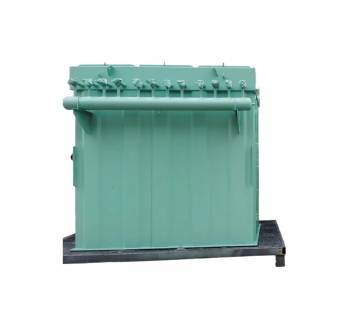
Dust collector
This series of products can be widely used in dust collection systems such as crushing, packaging, warehouse r....
Consult Now
PRODUCT
This series of products can be widely used in dust collection systems such as crushing, packaging, warehouse r....
Consult Now1、 Overview
This series of products can be widely used in dust collection systems such as crushing, packaging, warehouse roofs, clinker coolers, and various grinding machines in cement plants. If used for coal mill dust collection, explosion-proof measures should be added, and the structure of the dust collector should also be changed accordingly. It is also suitable for dust collection of gases with extremely high dust concentration, such as the grinding system with O-Sepa powder selector. If the gas dust concentration is above 1000g/m3 (standard), this series of dust collectors should be used for dust collection. In addition to being used in the cement industry, it is also suitable for dust collection of exhaust gases from metallurgy, chemical industry, machinery, and civil boilers. The material of this series of dust collector filter bags is generally polyester needle punched felt, which allows continuous use at temperatures below 140 ℃. If the filter bag uses high-temperature filter cloth. It allows the use of temperatures up to 300 ℃, but the filter material made of this material is expensive. If the temperature of the treated exhaust gas is higher than the allowable temperature of the filter material mentioned above, cooling measures should be taken before the exhaust gas enters the dust collector.
This series of dust collectors is designed for indoor and outdoor use, consisting of various sizes with different numbers of rooms and bags per room. The number of bags in each room is 32, 64, 96, and 128, with a total of 33 specifications in the entire series. The diameter of the filter bag is 130mm, and the length of the filter bag is 2450mm and 3060mm. This dust collector can operate under negative or positive pressure, and its body structure can be appropriately changed. Its dust collection efficiency can reach over 99.8%, and the dust concentration of the purified gas is less than 50mg/m3 (standard). The main technical performance of the dust collector in this system are shown in Table 2, Table 3, and Table 4, respectively. If this series of dust collectors is used in cold regions, when the calculated outdoor heating temperature is ≤ -25 ℃, a heating device should be added, and the shell of the dust collector should also be modified and insulated accordingly.
2、 Construction and working principle
This series of dust collectors consists of a housing, filter bag, ash hopper, ash discharge device, bracket, and pulse cleaning system. When the dusty gas enters the dust collector from the air inlet, it first hits the inclined partition in the middle of the air inlet, and the airflow turns to flow into the ash hopper. At the same time, the airflow speed slows down. Due to the gravity settling effect, the coarse particles of dust in the gas directly fall into the ash hopper, playing a role in pre dust collection. The airflow entering the ash hopper then bends upwards and passes through the filter bag with a metal frame inside. The dust is captured on the outer surface of the filter bag, and the purified gas enters the clean room at the upper part of the filter bag chamber, where it is collected and discharged through the air outlet pipe. The air inlet of the 32 type dust collector is located on the ash hopper. After the airflow enters the ash hopper, it first collides with the baffle at the end of the air duct. Its function is the same as the above principle. The shell plate is divided into several independent dust collection chambers by partitions, and each dust collection chamber is cleaned alternately at given time intervals. Each dust collection chamber is equipped with a lift valve. When cleaning, the lift valve is closed to cut off the filtered airflow through the dust collection chamber. Then, the pulse valve is opened to spray high-pressure clean air without water or oil into the filter bag to remove dust on the outer surface of the filter bag. The pulse blowing width and cleaning cycle of each dust collection chamber are automatically and continuously controlled by a dedicated cleaning degree controller. The structure and principle of the dust collector are shown in Figure 1, Figure 2, and Figure 3.



